
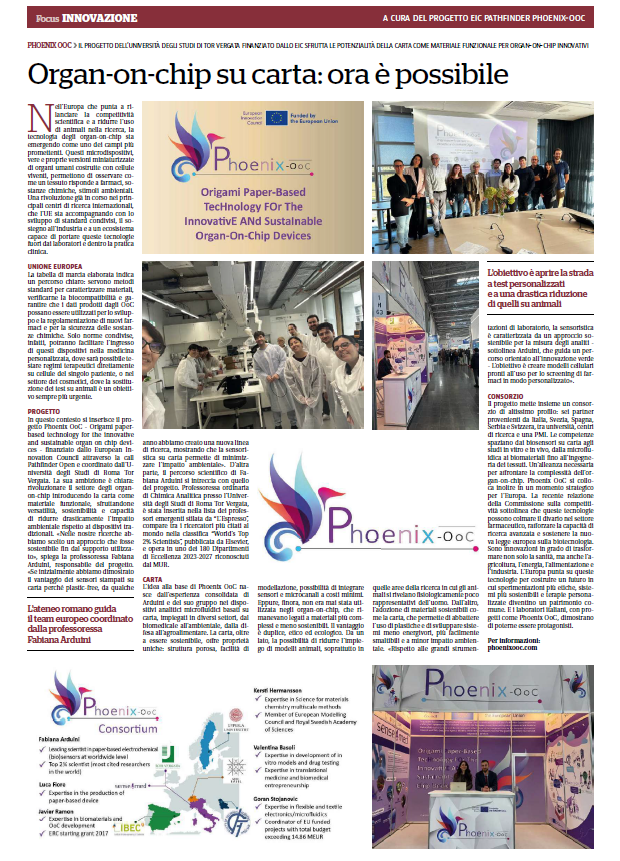
PHOENIX-OoC Featured in La Repubblica: Bringing Organ-on-a-Chip Innovation to the General Public
On November 18th, 2025, La Repubblica, one of the most widely read national newspapers in Italy, dedicated a full-page feature to the rapid evolution of biomedical research technologies and their transformative impact on healthcare. The publication represented a high-visibility dissemination opportunity for the PHOENIX-OoC project, aligning with the European Union’s strategic priorities to strengthen innovation capacity and reduce the use of animal models in biomedical testing.
By presenting the project in a mainstream media outlet rather than a specialised scientific context, the article significantly broadened the audience exposed to Organ-on-a-Chip technologies, reaching not only the scientific community but also clinicians, industry leaders, policymakers, investors and the general public.
The national distribution of La Repubblica in both print and online formats enabled wide dissemination of PHOENIX-OoC’s objectives within the broader biomedical ecosystem, contributing to increased public awareness of sustainable, next-generation preclinical testing platforms. This event supported the positioning of the project as a relevant actor within the European biomedical landscape, where technological innovation, ethical experimentation and regulatory transitions are converging to redefine future healthcare models.
Read the full article HERE.
The article provided an in-depth overview of current trends in the biomedical sector, illustrating how Organ-on-a-Chip (OoC) technologies have emerged as a strategic response to the limitations of traditional in vitro and in vivo experimentation. It emphasized the potential of these microphysiological systems to reduce animal testing, support patient-specific therapeutic choices and enhance predictive capabilities in drug discovery and toxicological screening, core priorities of European biomedical policy.
Within this context, PHOENIX-OoC was introduced as a pioneering research initiative funded by the European Innovation Council. The article described how the project departs from conventional OoC technologies by using paper as a functional structural material, enabling low-cost fabrication, sustainability, portability and the integration of biosensors directly into the device architecture. This approach opens new opportunities for biomedical applications, ranging from personalised diagnostics to environmentally responsible experimentation.
The article also contextualised the project within the broader European push for technological sovereignty, regulatory harmonisation and enhanced competitiveness in the biomedical domain. By presenting the consortium’s interdisciplinary expertise, spanning analytical chemistry, tissue engineering, microfluidics and sensor development, the article conveyed PHOENIX-OoC’s potential to reshape preclinical practice and contribute to a more ethical, green and patient-oriented biomedical future.


